
Published May 27, 2026
This Development Will Change Baltimore FOREVER (Inner Harbor)

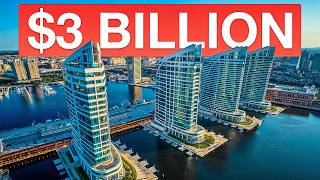
Baltimore Real Estate Guide: The $900 Million Harborplace Project That Will Change the City Forever
Most locals think Baltimore's waterfront is stuck in the past. That ends in 2026. A $900 million redevelopment project is about to deliver five new buildings, a 2,000-seat amphitheater, floating wetlands, and over 18 acres of new public space in the heart of the Inner Harbor. And Harborplace is only one piece of a larger $3 billion waterfront transformation that will reshape Baltimore for the next century.
I am Nick Waldner, founder of the Waldner Winters Team, based in Columbia, Maryland. My team helps over 500 families a year buy and sell homes across Maryland, and after 22 years in this market, I can tell you the Harborplace project is the single biggest catalyst Baltimore real estate has seen in a decade.
Here is the full breakdown of what is being built, when it is happening, and what it means for Baltimore real estate values heading into 2026 and beyond.
1. The Scope and Vision Behind the Harborplace Project
The Harborplace project spans 20 acres of downtown Baltimore waterfront, with more than 18 of those acres becoming public space. That is a massive jump from what is there today.
Voters approved the project through Question F in November 2024, passing with 60% of the vote. About 127,000 Baltimore residents voted yes, with 84,000 voting no. The Maryland Supreme Court ruling in October 2024 cleared the way for construction to move forward.
MCB Real Estate is leading the transformation. They acquired Harborplace in 2022 through a court order after the previous owner, Ashkenazy Acquisition Corporation, defaulted on a $76 million loan. Ashkenazy had purchased the property for $98 million in 2014 but could not make the payments.
The design team is world-class. Gensler, one of the top architectural firms in the world, is leading the master plan. STV is handling site design, engineering, and landscape work. Hoerr Schaudt from Chicago and Floura Teeter from Baltimore are working on landscape design. This is an A-list team for a project of this scale.
MCB spent significant time on community engagement before finalizing plans. They held meetings across more than 80 Baltimore neighborhoods, large public sessions, small dinner conversations, and ran an online input platform. Seven guiding principles came out of that process: economic sustainability, water connectivity, accessibility for everyone, local business focus, environmental resilience, safe and welcoming public spaces, and equity at the core.
P. David Bramble, co-founder and managing partner of MCB Real Estate, said it best. Baltimore's Inner Harbor is the beating heart of the city, and the goal is to bring world-class design and planning to one of the most special waterfront locations in the country.
2. What Is Actually Getting Built
The Harborplace project includes five buildings. Two apartment towers anchor the residential side. Tower One will be 32 stories, Tower Two will be 25 stories, delivering 900 new apartments combined.
The Sail building won an international design competition with a design inspired by water. It will house a marketplace on the first two floors with restaurants, event spaces, and businesses on the upper levels.
203 East Pratt Street sits between The Sail and the World Trade Center, offering waterfront commercial space with public space underneath a cantilevered second floor. 303 Light Street includes apartments on the upper floors plus two floors of shopping, dining, and community space at ground level.
The public spaces are what will transform how people use the waterfront. The Park at Freedom's Port replaces the current McKeldin Plaza and includes a 2,000-seat amphitheater, raised dining and gathering areas, and an arts and cultural retail corridor along the eastward extension of Camden Street. MCB is calling this the front porch of Baltimore City.
The Crescent is a two-level promenade connecting the Park at Freedom's Port to the rest of Harborplace. A 50,000 square foot publicly accessible rooftop park sits on one of the Pratt Street buildings, with views that will be unlike anything else in the city.
Between the National Aquarium and Pier 1, floating wetlands are being installed as constructed prototypes to support marine life and improve water quality in the Chesapeake Bay.
3. Retail, Dining, and Connectivity
The project will deliver over 300,000 square feet of business space including retail shops, restaurants, dining venues, and a marketplace concept inside The Sail. MCB has already started bringing in local businesses through their Boost program. When MCB acquired the property, only 29% of the spaces were leased. As of March 2024, occupancy had climbed to 60%.
Current tenants include Crust by Mack, Chef Kenny's restaurant (known for award-winning crab cakes), Pandora's Box (a gift shop expanded from Federal Hill), and a pop-up art showcase featuring over 60 local Black artists.
The project will not add new parking garages on site, but plenty of public parking is already available within one block. The plan emphasizes walking and transit. The Charm City Circulator free shuttle already covers the Inner Harbor, Fells Point, and Federal Hill, and the site is an easy walk to Harbor East, Little Italy, Fells Point, Canton, and Federal Hill.
The existing Inner Harbor still anchors the area with major attractions. The National Aquarium, the Maryland Science Center, the Top of the World observation level, the USS Constellation, the Pride of Baltimore II, and a 7.5 mile waterfront promenade from Canton to Locust Point with paddleboard rentals and boat tours.
4. The Economic Impact on Baltimore
The Harborplace project represents a $900 million total investment, with $400 million in public funds for roads and public space improvements and $500 million in private capital from MCB Real Estate. Additional federal grants are expected for waterfront road upgrades.
A 2025 economic impact analysis from the Jacob France Institute at the University of Baltimore estimates that the combined Harborplace and Downtown RISE initiatives will generate more than $2.1 billion in economic activity, support 11,000 jobs, and produce $96.3 million in state and local tax revenue during development.
Once operational, the annual economic impact is expected to reach $500 million in Baltimore, supporting 2,500 jobs, $200 million in worker earnings, and $15.7 million in annual city tax revenue.
But Harborplace is just one piece of the bigger picture. The full waterfront transformation is a $3 billion initiative spanning 231.5 acres across four major projects: Harbor Point at $1 billion across 27 acres, Baltimore Peninsula at $1.1 billion across 177 acres, Rash Field at $34.8 million across 7.5 acres, and the $900 million Harborplace project. This is the largest coordinated waterfront redevelopment in Baltimore's modern history.
The market is already responding. Baltimore saw population growth for the first time since 2014, adding over 750 residents in 2024. The broader Baltimore metro added 11,000 people in 2024. Multifamily sales in Baltimore City passed $460 million in 2024, the third highest transaction volume of the past decade, with over 2,500 housing units under construction as of early 2025.
Baltimore City's median listing home price is around $245,000, up from last year. The average home value is around $185,000, up 1% year over year. Inner Harbor specifically is running stronger, with the median condo listing price around $489,000, reflecting the waterfront location and urban amenities.
5. The Timeline and When Construction Actually Starts
Here is the path so far. In 2014, Ashkenazy Acquisition Corporation acquired Harborplace for $98 million. In 2019, they defaulted on the $76 million loan. In 2022, MCB took ownership through a court order. In early 2023, MCB began community engagement. By 2023 to 2024, the design team was named and the property closed. April 2025 confirmed Gensler as lead architect and STV as site design lead. May 2025 brought endorsement from the Maryland League of Conservation Voters. September 2025 confirmed the timeline and current project risks.
Right now, pre-construction activities are underway. Each building is moving through its own city approval process. Street changes are finalized, and permits are in active processing. Project risks include public funding coordination, permit timing, building cost inflation during approval delays, and the complexity of multiple parallel approval tracks.
Construction is set to start in fall 2026. From 2026 onward, a phased build will unfold over the next seven years, with apartments delivered in phases, public spaces built step by step, staged road improvements, and a rebuilt walkway from the National Aquarium to Rash Field Park. Full completion is expected over the next seven years.
Sustainability is a major factor influencing the timeline. The lower walkway is designed to float for climate resilience. Raised structures protect against flooding. Roads are engineered for higher water levels. Storm water management includes softer shorelines and new treatment systems. Green infrastructure runs throughout the site, and the floating wetlands between the National Aquarium and Pier 1 protect the Bay ecosystem. The full project is designed to function as a 100-year model for sustainable waterfront development.
What Local Insight Do Most Baltimore Buyers Miss?
Most buyers are watching the Harborplace project itself, but the real opportunity is in the surrounding neighborhoods. Harbor East, Federal Hill, Fells Point, Locust Point, and Canton are all going to feel direct pricing pressure as the waterfront transformation unfolds between 2026 and 2033. Properties within walking distance of the new Park at Freedom's Port and The Sail are going to capture appreciation that has not been priced in yet. Buyers who position now in these neighborhoods, especially condos with water access or proximity to the Charm City Circulator routes, are going to look very smart five years from now. This is the kind of generational catalyst Baltimore has not had in decades.
Frequently Asked Questions About the Harborplace Project in 2026
Q: What is the Harborplace project in Baltimore?
A: The Harborplace project is a $900 million redevelopment of 20 acres on Baltimore's Inner Harbor waterfront. The project includes five new buildings with 900 apartments, a 2,000-seat amphitheater, a 50,000 square foot rooftop park, floating wetlands, and over 18 acres of new public space led by MCB Real Estate with master plan design by Gensler.
Q: When does construction on the Harborplace project start?
A: Construction is scheduled to begin in fall 2026. The full build will be phased over approximately seven years, with apartments, public spaces, and road improvements delivered in stages through the early 2030s.
Q: How will the Harborplace project affect Baltimore real estate values?
A: The project is expected to drive significant appreciation across Baltimore's downtown and waterfront-adjacent neighborhoods including Harbor East, Federal Hill, Fells Point, Locust Point, and Canton. Combined with the broader $3 billion waterfront transformation, economic activity is projected to top $2.1 billion during development, with $500 million in annual economic impact once operational.
Q: What is being built at Harborplace in Baltimore?
A: The Harborplace project includes two apartment towers (32 stories and 25 stories with 900 apartments combined), The Sail building with marketplace and event space, 203 East Pratt Street commercial space, 303 Light Street with apartments and retail, a 2,000-seat amphitheater at the Park at Freedom's Port, The Crescent two-level promenade, a 50,000 square foot rooftop park, and floating wetlands near the National Aquarium.
Q: Is now a good time to buy real estate in Baltimore?
A: Yes, especially in neighborhoods near the Inner Harbor. Baltimore saw population growth for the first time since 2014, the metro added 11,000 residents in 2024, and over 2,500 housing units are under construction. With the $3 billion waterfront transformation underway, buyers who position now in downtown and waterfront-adjacent neighborhoods are likely to capture significant appreciation through the construction phase and beyond.
Ready to Take Advantage of Baltimore's Waterfront Transformation in 2026?
I am Nick Waldner, founder of the Waldner Winters Team in Columbia, Maryland. For 22+ years, my team has helped over 500+ families a year buy and sell homes across Maryland, including some of the most competitive Baltimore neighborhoods. We know exactly which Inner Harbor, Harbor East, Federal Hill, and Fells Point properties are positioned to capture the most upside from the Harborplace project and the broader waterfront transformation.
Call us at 443-472-4474 or visit findmarylandhomelistings.com to start the conversation. You can also download our free Maryland Relocation Guide for full neighborhood breakdowns, school details, and investment insight before you commit.
Connect With Nick and the Waldner Winters Team
Website: https://findmarylandhomelistings.com
YouTube: https://www.youtube.com/channel/UCX9HS6Ox4HirFMCX_P-TZxA
Facebook: https://www.facebook.com/waldnerwintersteam/
Instagram: https://www.instagram.com/thewaldnerwintersteam/
Watch the original video: https://www.youtube.com/watch?v=Orv8imTGqc0


or another way